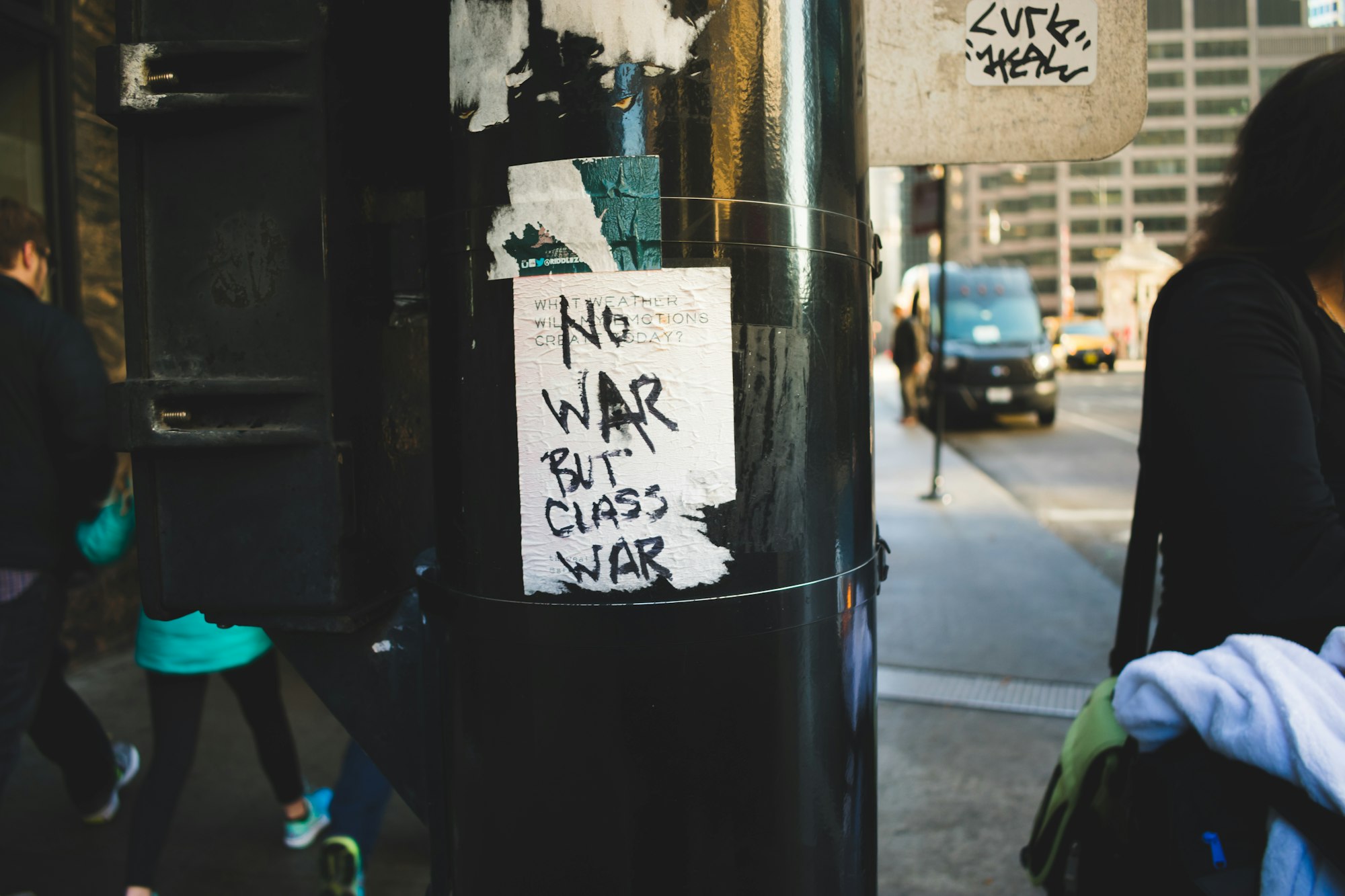
Jean Baudrillard, the French philosopher and long-time hero of mine, once made the provocative claim that "the Gulf War did not take place."
As I write this, I'm sitting in a forest a few kilometres outside Warsaw. The trees are doing what trees do. Somewhere behind me, a dog is being called back by its owner in Polish - Chodź tu! Chodź! - and the sound carries through the air with a clarity that feels almost aggressive in its realness. Pine needles. Mud. The particular quality of late winter light through birch trees, which is to say: thin, honest, unedited.
My phone, on which I'm typing, clutched in both hands, contains something special - presumably - a war.
Humour me.
A brief reminder about Monsieur Baudrillard.
Baudrillard's argument, in its bluntest form, was this: that in contemporary society, the representation of reality has become more real than reality itself. He called this condition hyperreality. The simulation doesn't follow the event - it precedes it. The map comes before the territory. The sign circulates freely, untethered from whatever it was supposed to signify.
He outlined what he called the precession of simulacra - a series of stages through which a representation progressively detaches from reality. First, it reflects reality. Then it masks and distorts it. Then it masks the absence of reality. Finally, it bears no relation to any reality whatsoever. At that point, you are no longer dealing with representation. You are dealing with pure simulation.
Are you still with me?
He famously applied this to the Gulf War of 1991, arguing that what we experienced wasn't a war but a media production - a spectacle of precision, of briefings, of sanitised aerial footage - that substituted so completely for the actual conflict that the actual conflict became, in a meaningful sense, beside the point.
It's a deeply uncomfortable idea. It was in 1991. It remains so now.
Back to the war in my phone - Iran.
Operation Epic Fury.
That's what they called it. On the American side, at least. The Israelis went with Operation Roaring Lion. Iran's retaliation was named Operation True Promise IV - which, if you're paying attention, implies a franchise. There were a first, second and third. The serialisation of conflict, branded and sequenced, ready for the next season.
These names were chosen before a single missile was launched. They were designed - branded, focus-grouped for resonance - in advance of the events they describe. They exist to be reported, to be repeated, to circulate across chyrons and push notifications and social media posts. They are the simulation preceding the real. The packaging arriving before the contents.
Baudrillard would have found this almost too easy.
And then there is the matter of how the opening act was announced. At exactly 2:30am EST on 28 February, Donald Trump released an eight-minute video statement on Truth Social - the same platform typically used to post grievances and capitalised declarations - informing the world that the United States was at war with Iran. The choice of platform is not incidental. Truth Social is itself a simulacrum of a public square, a produced environment in which the performance of communication substitutes for communication itself. A war announced and a war that understands, from its very first moment, that the spectacle is the point.
The breakthrough that wasn't there.
Let's wind the clock back twenty four hours. On 27 February 2026, Oman's Foreign Minister - who had been quietly mediating nuclear talks between Washington and Tehran - announced that a breakthrough had been reached. Peace, he said, was "within reach." Iran had agreed to never stockpile enriched uranium. Verification by the IAEA. Serious, substantive progress, he suggested, after months of careful diplomacy.
The bombs fell the following morning.
Now, you might read this as cynical diplomacy, or bad faith negotiation, or geopolitical calculation of a kind that has always existed and always will. All of those things might be true. But Baudrillard would offer a different reading: the sign of peace was entirely real. The sign circulated. It was reported. Oman's Foreign Minister believed it. And yet it bore, apparently, no relationship whatsoever to any actual peace process that was capable of stopping what happened next.
This is what he called the fourth order of simulacra: the sign that bears no relation to any reality whatsoever.
The breakthrough was real. The peace was not.
The media as theatre of operations.
So, turn on the news. Any news. Pick your outlet, your language, your preferred register of outrage or endorsement.
What you will find is: a live tracker. A casualty counter, refreshing in something close to real time. Graphics. Maps with arrows on them, confident arrows, drawn by people who have presumably been handed a brief and a deadline. Analysts in suits explaining, with great authority and considerable fluency, the strategic logic of strikes on targets whose names most of them couldn't have located on a map a fortnight ago. Lower thirds scrolling. Breaking news that was breaking an hour ago and will continue to break, indefinitely, because the format requires it.
And there is footage. Plumes of smoke over Tehran. The glow of something, somewhere, burning. An airport concourse with staff fleeing through it. The Burj Al Arab - the sail-shaped hotel that functions as a kind of global shorthand for excess - with smoke rising improbably nearby. Drone footage, the grammar of which we have all now fully absorbed, the cool overhead geometry of destruction that makes everything look, from sufficient altitude, like a simulation.
What there is very little of: the experience of being inside any of this. The texture of it. The particular quality of air in a city being bombed, which is not something that compresses into a ninety-second package without losing almost everything that makes it real.
Baudrillard's point was never that the media lies, exactly. The argument is subtler than that, and more troubling. It's that the media replaces. The coverage becomes the dominant reality - more vivid, more immediate, more present than anything we could access directly. We watch the casualty counter climb the way we watch a stock price. We absorb the expert panel the way we absorb a weather forecast. The numbers are real. What they represent recedes behind the interface.
At some point - and this is the uncomfortable question - does it matter whether the war is happening, if the experience of it happening is this total, this consuming, this thoroughly mediated?
The simulation of justification.
US Treasury Secretary Scott Bessent said earlier this year that Washington had deliberately engineered a dollar shortage in Iran to send the rial into free-fall. The resulting economic collapse produced - entirely predictably - mass protests across more than a hundred Iranian cities. The protests were then cited, by the same Washington that had engineered the conditions for them, as evidence of a population yearning for liberation. The liberation was then delivered, from altitude, at 2:30 in the morning.
The cause was manufactured by the people who cited it as justification.
Baudrillard argued that in the age of simulacra, power is no longer exerted through direct force but through the manipulation of signs and symbols. The protests were real. The suffering that produced them was real. The people in the streets were real people, with real grievances. And yet they also functioned, with extraordinary systemic efficiency, as a simulation - as a produced sign of consent, ready to be cited when the moment required it.
Whether any of this was cynically intended is, in a way, the wrong question. The system doesn't require intention. It only requires the sign to circulate.
What it does to us.
There is a version of this argument that ends with a comfortable shrug - well, everything is representation, what can you do - and Baudrillard was not entirely innocent of enabling that shrug. His critics said as much, and they weren't entirely wrong.
But I think the more honest application of his thinking points somewhere less comfortable: toward the audience. Toward us, specifically. The people consuming this on phones, on laptops, in living rooms, in - yes - forests outside Warsaw.
We are not passive recipients of a simulation that happens to us. We participate in it. Every time we share a piece of footage without knowing its provenance, every time we absorb an operation name as though it were a neutral descriptor, every time we allow the live tracker to give us the satisfying sensation of being informed - we are doing something. We are, in Baudrillard's terms, completing the circuit.
The question he leaves us with - and it is not a comfortable one - is whether, given all of this, it is possible to find our way back to something we might cautiously call the real. Or whether that ship, as they say, has sailed. Or been sunk, by a US submarine, somewhere off the coast of Sri Lanka, in a conflict that is simultaneously happening and not happening, everywhere and nowhere, urgent and utterly abstract.
Back to the forest.
Well... I think the dog has long since been retrieved. The birch light has shifted slightly. My phone is getting hot. My backside has gone numb. I'll edit this later on. But remember...
Somewhere - on a screen, on a feed, in a live blog refreshing every forty seconds - a war is taking place. Or rather: a war is being represented, packaged, named, tracked, analysed, condemned and celebrated simultaneously, by parties with entirely incompatible accounts of what is real and what is happening and why.
Baudrillard never told us what to do with this. He was infuriating like that. He offered the diagnosis and declined the prescription. Make of it what you will.
But I do think there's something worth sitting with, in the quiet, away from the screens: the degree to which our experience of this conflict - of any conflict - is constructed for us, in advance, by forces with considerable interest in what we conclude from it.
The war in Iran may or may not be taking place.
The representation of it, certainly, is.
 David Henzell