

Please check back for updates.
A Sonic Investigation of the Performed City
Something I've noticed about Warsaw - and I've spent enough time walking her to have noticed a few things - is that she makes a very particular kind of noise. Not just loud, or Eastern European, or post-communist. Something more intentional than any of those. Something that takes a while to identify because you first have to stop walking quickly, stop having somewhere to be, stop letting the sound wash over you as ambient backdrop and start actually attending to it.
When I started doing that - attending, genuinely - I realised I was hearing a city that had learned something most cities never have to learn. How to perform being itself.
Warsaw was 85% destroyed by the Nazis. What exists now was essentially rebuilt from paintings, photographs, survivors' memories. Which means the Old Town you're walking through, the cobblestones under your feet, the particular acoustic texture of those narrow streets - all of it is reconstruction. Not fake, exactly. But not original either. Something that exists in the gap between those two categories, and has made peace with that gap. Warsaw already knows that presence is a rehearsed act. That being a place is a performance. The field recordings are just me trying to listen to that performance seriously.
This is Warsaw Fields.
Over the course of my months living here - and I mean living, sequential residency, not tourism, no hotel key, actual keys - I've been recording the city. Metro platforms at 07:30 when the commuter rhythms are most legible. Tram routes where the infrastructure sings its own frequency. Underpasses with reverb profiles that feel almost designed. Markets that sound spontaneous but follow, on closer listening, carefully managed schedules. Reconstruction sites where new concrete is attempting to approximate the acoustic signature of buildings that no longer exist.
Two microphones, very different philosophies. The Zoom Binaural Mic captures space as you'd experience it inside a human head - immersive, first-person, embodied. You put headphones on and you inherit my position in the performance. You become the body standing on that platform, in that particular spot, on that particular morning. The Teenage Engineering CM-15 is more surgical. Where the binaural says here is the world as I experienced it, the CM-15 says here is the thing I chose to isolate. Together they form a two-stage editorial question I keep asking myself: what kind of listening am I performing, and what am I declaring worthy of attention?
These aren't rhetorical questions. They're the actual methodological spine of the project.
Every recording in the catalogue exists in two versions. The dry recording is Warsaw as captured. Which sounds like neutral documentation until you examine what that means. Every recording is already an editorial act - where you point the microphone, when you press record, how long you attend, what you decide is signal versus noise. Transparency is an illusion we apply to recordings the same way we apply it to photographs. The frame is always there. The position of the recordist is always present in what gets captured.
The wet sculpture makes that mediation explicit rather than hiding it.
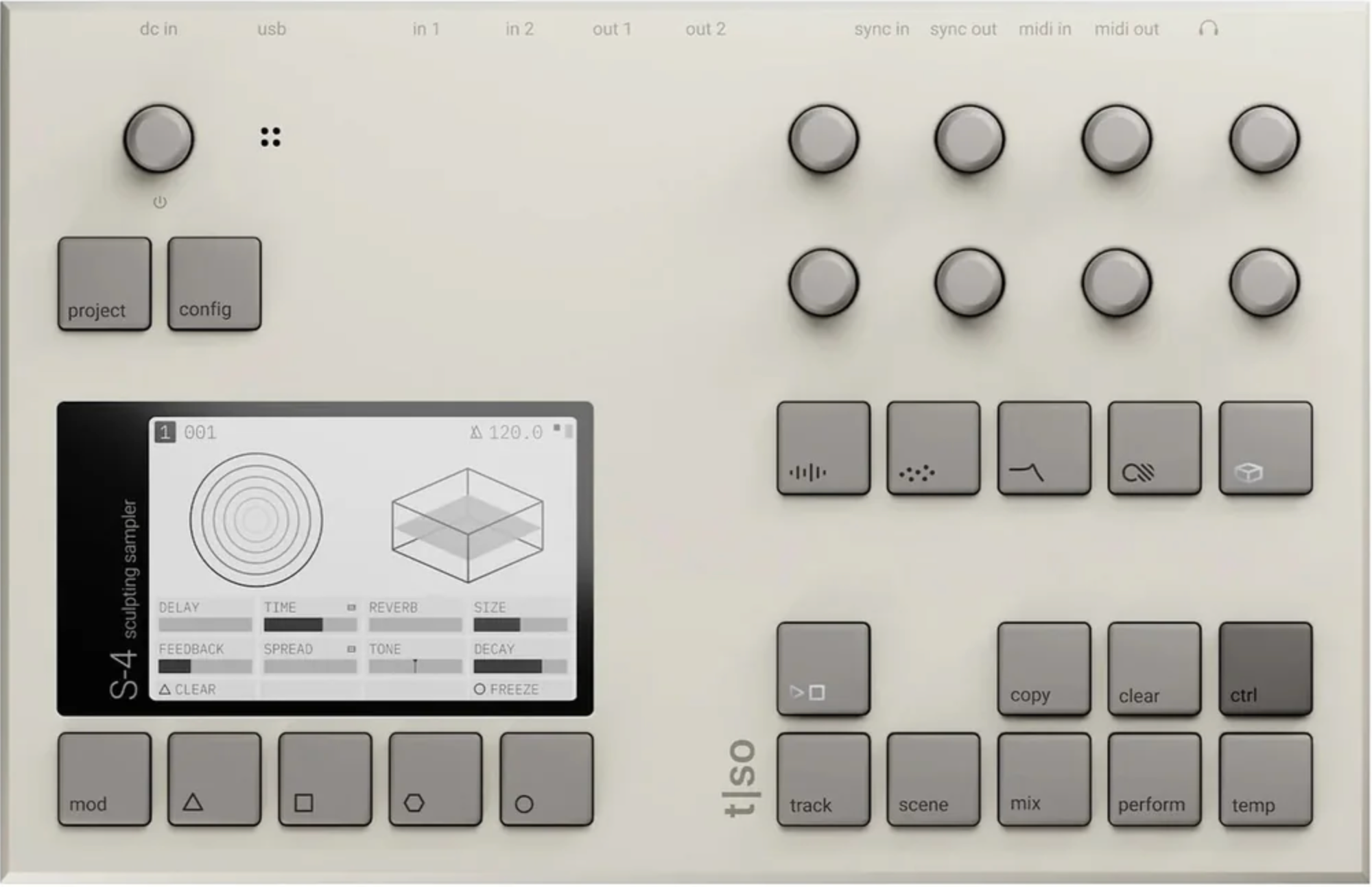
Using a Torso S-4 synthesiser - processed live, not constructed in post-production - I work through each dry recording: granular synthesis, spectral filtering, distortion, spatial reconstruction. Not to decorate the original. To surface what's latent inside it. Metro door pneumatics stretched into a sustained 62Hz drone that reveals the frequency the system was generating all along, underneath its functional surface. Footstep rhythms that align, when slowed and isolated, with a human heartbeat - suggesting something about how infrastructure shapes biological response that you'd never notice in real time. Reconstruction site recordings where you can hear new materials trying to sound old, and failing in exactly the ways that make the attempt interesting.
The wet version doesn't tell you what Warsaw sounds like. It tells you what Warsaw is performing through its sound. And what that performance reveals about simulation, reconstruction, and the production of urban meaning.
The theoretical frameworks I'm working with - Baudrillard on simulation and hyperreality, Debord on the spectacle, Virilio on speed and acoustic texture - aren't window dressing. They're the analytical lens. Baudrillard because Warsaw is a city of simulacra, where the reconstructed spaces have in some sense become more real than the originals they reference. Debord because the sonic environment of any major city isn't accidental; it's produced, managed, shaped to create specific sensations. Virilio because speed leaves acoustic traces, and Warsaw is accelerating in ways that are audible if you know where to listen.
Each recording in the catalogue comes with a critical essay that works through these frameworks. I've tried hard not to let the theory swallow the prose - to always return to the sound itself, to what Warsaw is doing when it makes that particular noise. Whether I've succeeded is for you to decide.
The catalogue is organised into four thematic collections. Not geographic - conceptual. Because Warsaw doesn't make sense as geography; it makes sense as a set of overlapping performances, each with its own acoustic logic.
[World Underground - In Progress] is the Metro. Subterranean theatre. The particular silence between stations. The way the system produces a sensation of managed calm so thorough that it barely registers as produced at all. This is Baudrillard's territory - a space so efficiently simulated that the simulation becomes the reality, and the reality becomes irrelevant.
[Gliding - In Progress] is frictionless urban movement as sonic quality. Trams, cyclists, pedestrians who have learned to move through the city without friction. The acoustic texture of a place designed - deliberately, infrastructurally - to allow certain kinds of movement and impede others. If you've read my piece on the metro glide, this is where that thinking goes sonic.
[Sonic Objects - In Progress] is the micro. Isolated sounds and their hidden architectures. A single door. A single announcement. A single frequency that runs beneath an entire district's acoustic environment without anyone consciously registering it. The CM-15's territory - the pointed, selective, declarative act of listening.
[Reconstruction - In Progress] is the one that feels most specific to Warsaw. The city's relationship to its own performed history. New materials trying to sound old. The acoustic gap between the photograph used as a blueprint and the building constructed from it. What gets lost in that gap, and what strange new things emerge to fill it.
A word about what this project isn't, because I think it matters.
It's not a comprehensive acoustic survey of Warsaw. I haven't covered the city systematically, haven't attempted representational balance, haven't tried to document every district or demographic. It's not neutral documentation - I've already explained why I don't think neutral documentation exists, but even within that, this is particularly situated. One person's ears, one theoretical lens, one set of equipment choices, one set of afternoons and mornings where the light was particular and I happened to have the microphone out.
The wet recordings are even more explicitly subjective. Each one is a specific critical encounter between the dry material and the interpretive framework, performed live on a particular day. Someone else would make different sculptures from the same source material. That's the point. Making the subjectivity explicit is the entire methodological premise. All listening is interpretation. Warsaw Fields just tries to be honest about that rather than disguising it as objectivity.
What I hope you hear, through both versions and the essays that accompany them, is Warsaw performing herself. The city that rebuilt from photographs and learned, in doing so, that reconstruction is just another word for presence.
The four collections will be linked above as they develop. Each one will hold the dry recording, the wet sculpture, and the essay that tries to say what I heard inside what I heard.
Start wherever you like. There's no correct order. Cities don't have one either.


